Sports Injury Treatment: What to Do in the First 48 Hours
What you do, or don't do, in the first 48 hours after a sports injury can meaningfully affect how quickly and how completely you recover. Sports and recreation injuries send an estimated 2.7 million people to the emergency department each year among those ages 5 to 24 alone. Here's a general guide to that early window.
The instinct to push through it usually backfires
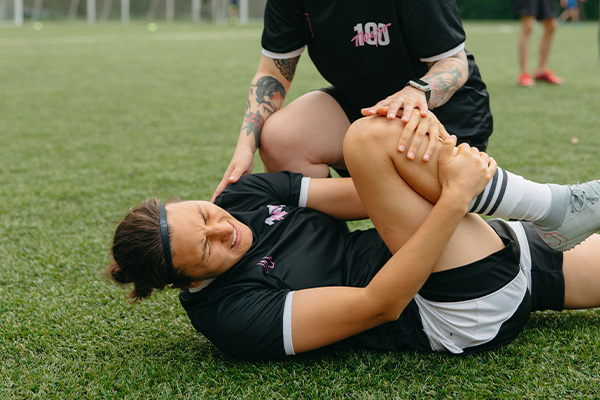
For a lot of athletes, the instinct after a sudden injury is to keep going, especially mid-game or mid-competition. That instinct is understandable, but it's also one of the more common ways a manageable injury turns into a more serious one. Continuing to load an already-injured structure, even briefly, can turn a mild strain into a significant tear, or a minor sprain into real ligament damage.
General guidance for the first 48 hours
A commonly used framework for this early window is remembered by the acronym POLICE: Protection, Optimal Loading, Ice, Compression, Elevation, an update to the older RICE (Rest, Ice, Compression, Elevation) approach that reflects a shift in how the research is understood. The evidence on muscle injury recovery supports a short period of rest right after an injury, generally less than a week, but keeping it brief matters, since prolonged immobility can work against healing rather than for it.
●Stop the activity. Continuing to play or train on a fresh injury is one of the most common ways to make it worse.
●Protect the area. Avoid movements that reproduce the injury while you figure out what's actually going on.
●Manage swelling early. Ice and elevation are commonly used in the first 24 to 48 hours to help manage swelling and discomfort, general first-aid measures, not a substitute for evaluation.
●Start moving again sooner than you might expect, once the acute swelling and sharp pain have settled. Prolonged rest beyond the first few days can slow healing rather than protect it.
●Don't rush back based on pain alone. Pain easing doesn't always mean the underlying tissue has healed enough to handle full activity again.
Signs that are worth seeing someone right away
Significant swelling, an inability to bear weight or use the limb normally, visible deformity, numbness or tingling, or a pop felt at the moment of injury are all reasons to be evaluated promptly rather than waiting to see if it improves on its own.
Why early evaluation matters more than people assume
A lot of athletes wait days or even weeks before getting a nagging injury looked at, hoping it resolves on its own. Sometimes it does. But an early evaluation can catch the difference between something that heals fine with a bit of rest and something that needs a structured plan, and starting that plan earlier generally means a shorter road back to full activity, not a longer one.
Note: This article is general first-aid-level guidance, not a diagnosis or a substitute for medical evaluation. Any injury involving significant pain, swelling, deformity, or inability to use the limb normally should be evaluated by a medical professional promptly. |
Frequently Asked Questions
Should I use ice or heat right after an injury?
Ice is generally recommended in the initial period to help manage swelling; heat is more commonly used later in recovery. A provider can give guidance specific to your injury.
How do I know if it's serious enough to see someone?
Significant swelling, inability to bear weight or use the area normally, visible deformity, or a pop felt at the time of injury are all reasons to be seen promptly, when in doubt, getting it checked is the safer choice.
Is it okay to keep training on the rest of my body?
Often, yes, but it depends on the specific injury. This is a good question to ask directly during an evaluation rather than guessing.
Is complete rest the safest option after a sports injury?
Not usually, despite how intuitive that feels. The research on muscle injury recovery supports a short period of rest, generally less than a week, but prolonged immobility can actually slow healing. A real evaluation can tell you when and how to safely start moving again.
Dealing with a fresh injury? Let's get it evaluated properly so you know exactly what you're working with, and when it's actually safe to get back to it. Curious whether dry needling could be part of your recovery? Read "Dry Needling vs. Acupuncture, Massage, Stretching, and Heat: What's Actually Different" |