Dry Needling vs. Acupuncture, Massage, Stretching, and Heat: What's Actually Different
If you've spent any time researching stubborn muscle pain online, you've probably run into dry needling, and probably seen it lumped in with acupuncture too. They share a tool, not much else. Here's an honest comparison of dry needling against acupuncture, massage, stretching, and heat, and where each one actually fits.
What "traditional" approaches are actually doing
Heat and ice change blood flow and nerve sensitivity at the skin and surface-muscle level. Stretching lengthens tissue and can temporarily ease tightness. Massage manipulates muscle from the outside, which can release tension and improve circulation. All of that is genuinely useful, and for a lot of everyday soreness, it's enough on its own.
Where these approaches tend to run into a ceiling is a specific kind of knot in the muscle called a trigger point, a small, tight band of muscle fiber that stays contracted even at rest, often refers pain to another area entirely (a tight spot in the shoulder blade that produces a headache, for example), and doesn't reliably respond to stretching or surface pressure alone.
What makes dry needling different
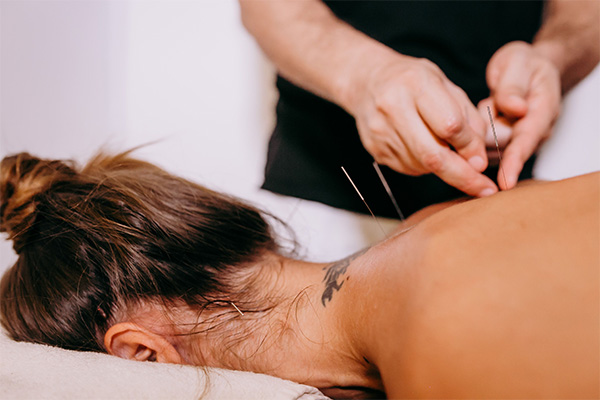
Dry needling uses a thin, solid filiform needle, the same type used in acupuncture, though the technique and theory behind it are different, inserted directly into that trigger point. The goal is a local twitch response: a brief, involuntary contraction of the muscle fiber that can interrupt the tight, contracted pattern the trigger point has been stuck in.
A 2016 systematic review of 19 randomized controlled trials found that trigger point dry needling produced a statistically significant reduction in pain compared to control groups in 14 of the 19 studies, with meaningful improvements in range of motion in several and broader function or quality of life in others.
Dry needling vs. acupuncture: same tool, different approach
Dry needling and acupuncture share a tool, a thin, solid filiform needle, and not much else. Acupuncture is rooted in traditional Chinese medicine and targets points along meridians, based on a framework that predates modern anatomy. Dry needling is grounded in a Western, musculoskeletal understanding of muscle and nerve anatomy, and targets specific trigger points directly, chosen based on where the muscle tissue is actually restricted.
Acupuncture does have real research behind it for certain conditions. The National Institutes of Health's National Center for Complementary and Integrative Health notes that acupuncture may help with several pain conditions, including back and neck pain, where a 2018 review found its pain-relieving effect comparable to that of nonsteroidal anti-inflammatory drugs, and knee, hip, or hand osteoarthritis, which a 2019 clinical guideline conditionally recommends it for. The evidence is weaker for other uses, including sciatica and cancer pain, where NCCIH notes the research hasn't been strong enough for definite conclusions.
In practice, the honest difference isn't that one approach is better than the other across the board, it's that they're built on different models of what's actually happening in the tissue. A provider trained in dry needling is specifically targeting a trigger point's local, mechanical behavior rather than working from a broader meridian-based framework. If you're deciding between the two, what matters more than the underlying theory is whether the specific provider you're seeing is well trained in the approach they're offering.
How it fits into a real treatment plan
None of these tools, dry needling, acupuncture, massage, stretching, or heat, work well in isolation from the rest of a plan. They're typically most useful as one piece of a broader approach that also addresses the underlying cause of the tension in the first place, whether that's a strength imbalance, a movement pattern, or a training load issue, rather than as a stand-alone fix on its own.
Note: This article is general educational information, not a diagnosis or treatment recommendation. Dry needling is not appropriate for everyone and should only be performed by a properly trained, licensed provider as part of a real evaluation of your specific situation. |
Frequently Asked Questions
Is dry needling the same as acupuncture?
They use a similar thin, filiform needle, but the underlying approach is different. Dry needling targets specific muscular trigger points based on a Western musculoskeletal model, while acupuncture is rooted in traditional Chinese medicine's meridian system. They're related tools, not the same practice.
Does dry needling hurt?
Most people feel a brief cramping or twitch sensation when the needle reaches the trigger point, which fades quickly. It's generally well tolerated, though sensitivity varies from person to person.
How do I know if I need dry needling, more stretching, or acupuncture?
That's exactly the kind of question a real evaluation is built to answer. Trying to self-diagnose a trigger point versus general tightness, or choosing between two different treatment philosophies, is hard to do accurately on your own.
Is acupuncture safe?
Generally, yes, when performed by a properly trained provider using sterile, single-use needles, which the FDA requires. Relatively few complications have been reported, and the ones that have tend to trace back to nonsterile needles or improper technique, not the approach itself.
Not sure which approach actually fits what you're dealing with? Every treatment on this list has its place. The right mix depends on what's actually going on in your body, not a theory. Let's talk it through. Here for the athletic performance angle? Read "Physical Therapy for Athletes: Performance and Pain Aren't Separate Problems" |