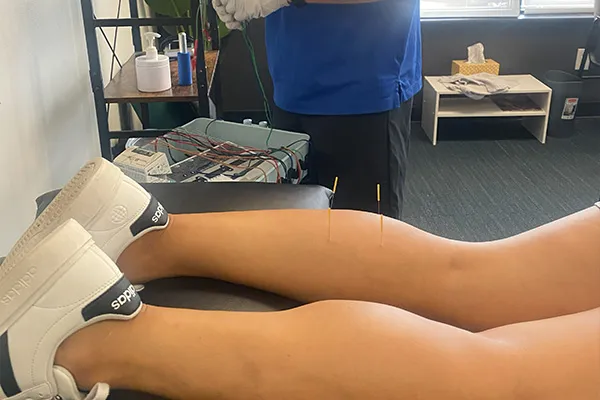
What Is Dry Needling? A Plain-Language Guide
Dry needling gets confused with acupuncture, dismissed as "just needles," or oversold as a miracle fix, depending on who you ask. Here's a plain-language version: what it actually is, what it isn't, what it feels like, and who it tends to be a good fit for.
What dry needling actually is
Dry needling is a technique where a thin, filiform needle (the same type used in acupuncture, though the theory behind it is different) is inserted into a specific muscle trigger point - a tight, irritable knot of muscle tissue that can cause pain locally or refer pain elsewhere in the body. The goal is to release that trigger point, reduce muscle tension, and improve movement.
It's called "dry" needling specifically because nothing is injected - no medication, no saline, nothing. That's the detail that distinguishes it from a "wet" needling procedure like a trigger point injection.
What it isn't
It isn't acupuncture, even though they share a tool. Acupuncture is rooted in traditional Chinese medicine and targets points along meridians; dry needling is grounded in a Western, musculoskeletal understanding of muscle and nerve anatomy and targets specific trigger points directly.
It also isn't a standalone cure. It's typically one part of a broader treatment plan that includes movement, strength work, and addressing whatever's actually causing the tension in the first place - not a substitute for that larger plan.
What the research says
A 2016 systematic review of 19 randomized controlled trials on trigger point dry needling found a statistically significant reduction in pain in 14 of the 19 studies, with additional improvements in range of motion and function in several others. That's a reasonably solid evidence base, though the review's authors also note that treatment approaches across studies weren't standardized, and more consistent research would strengthen the picture further.
What it actually feels like
Most people describe a brief, deep ache or a muscle twitch response at the moment the needle reaches an active trigger point - not the kind of sharp, surface-level pinch you might expect from a needle. Afterward, mild soreness similar to a tough workout is common for a day or two.
It's not painless for everyone, and reactions vary by person and by how irritable the specific muscle tissue is that day, but it's generally well tolerated.
Who it's generally a good fit for
Dry needling tends to be considered for people dealing with persistent muscle tightness or trigger-point-related pain that hasn't fully responded to other approaches - stretching, massage, general strengthening - on their own. It's not automatically right for everyone, and a real evaluation (not a self-diagnosis) should decide whether it fits your specific situation.
Note: This article is general educational information, not a diagnosis or treatment recommendation. Dry needling should only be performed by a properly trained, licensed provider as part of a real evaluation. |
Frequently Asked Questions
Is dry needling safe?
When performed by a properly trained provider, yes, generally. A review of over 7,600 treatments found mild, short-lived side effects like minor bruising or soreness in roughly 1 in 5 sessions, with no serious complications recorded in that data. Like any hands-on treatment, it carries some risk, which is why training and technique matter.
Does insurance cover it?
Coverage varies widely by plan and by how the clinic bills the service. Worth a direct call to both your insurance provider and the clinic before assuming either way.
How is it different from a massage?
Massage works on tissue from the outside, through pressure and manipulation. Dry needling reaches the trigger point directly with a needle, which can access deeper or more specific areas than manual pressure alone.
Think dry needling might be worth trying? Let's start with an actual evaluation, not a guess. We'll talk through what's going on and whether this is the right tool for it. Already sure and just want the practical details? Read "Dry Needling Near Me in Kearney, MO: Cost and How to Choose a Provider" |